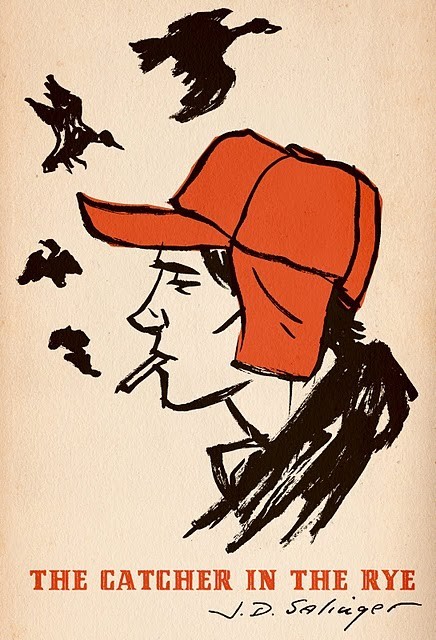
I was never assigned this book in high school
so I couldn’t bring that perspective to my reading of it. To be honest, when I started reading the first few chapters, my main reaction was, “Wow, this narrator is really unlikeable.”
However, I then had the idea to google the words “John Green, Catcher in the
Rye” and lo and behold a few years ago John Green had chosen this novel to read
together online with his "nerdfighter" fans and he made three videos in which he analyzed the
text. And this sort of saved my
reading of the book, took away that veil of annoyance I had placed on Holden,
because at the end of his intro video he gives the readers three things to keep
in mind as you’re reading, which in a way served in infuse my reading process
with a higher purpose:
the first one I’ll quote directly:
“In response to the common criticism
that Holden Caulfield, the narrator of the Catcher in the Rye, is unlikable; I
regret to inform you that you are also unlikable. So am I. There’s this like,
weird but pervasive feeling in the world of contemporary coming-of-age fiction
that characters ought to be, like, either the person you want to be or the
person you want to be with. And I am happy to acknowledge that Holden Caulfield
is not the guy you want to be or the guy you want to be with. He’s not Edward
Cullen. But he is the guy you secretly know yourself to be, which I would argue
is in the end more interesting.”
And the
last two things he said to keep a look out for: 2. Holden’s red hunting cap and
3. the fact that two stories are going on and there are two Holdens, the one
who is experiencing the events in the story and the one who his telling us
about them. For anyone else that has to read this book or is rereading it, I highly, highly recommend John Green's video discussion about it!
So along with keeping these ideas in mind, my professor also asked us to keep in mind two questions, which I'll copy here and attempting to answer these questions will be the bulk of this post:
1. Why are highschoolers assigned by parents and teachers to read this book? Why do adults tell them to read it, why do they think it's ok for teens, or "safe" for them to read?
2. Is it really a book about a teenager? If not, what is Salinger writing about?
In
response to why highschoolers are encouraged to read this text, I think part of
it is linked to the stereotypical idea of what adolescence is, about what most
teens experience, and the belief that either a book like Catcher can be a text that half of the class will relate to because
they are going through/experiencing similar episodes and perhaps the other half
of the class isn’t experiencing these things but by reading the book they will
be exposed to what Americans believe to be the typical nature of coming of age
and thus learn from that and also perhaps have experienced vicariously enough
that they themselves are not compelled to go out and do the same things as
Holden. Now, I get this
theory. I would love to conduct a
sort of survey and talk to teachers around the country, both those that assign
and don’t assign the text, and get their reasons for doing so.** (see note at
end of this post) So as I said while I get
this, I am not a fan of perpetuating the supposed normalcy of this kind of
adolescence and coming of age.
Perhaps this is because my adolescence was so different from the typical
trials and triumphs depicted in most contemporary/realistic YA fiction, from Catcher in the Rye to Looking for Alaska.

However,
I do think that now more than 60 years after Catcher in the Rye was written, perhaps this book should be the
least of parents worries. Young
adults are hearing and seeing things much “worse” than what happens in Catcher, which is sad, but unfortunately
true, especially if the state of young adults as related in fiction is to be
taken as evidence. For example, I personally would feel much more comfortable having a group of teenagers read Catcher in the Rye as opposed to Looking for Alaska (and I say
this despite the fact that I read the book this summer and enjoyed parts of it).
Looking for Alaska worked much more
at perpetuating how normal it is for teenagers in this century to for one still
be smoking, to be watching pornography, to be cursing in almost every sentence
for some characters (if people thought language was an issue in Salinger’s
work, Green takes it to another level just in terms of the amount of profanity
per word capita), and to be engaging in sexual activities (described much more
explicitly than Catcher). And not just in other texts are teenagers being exposed to
these sort of things, it’s all over the media, television, film and internet. However, as a fellow classmate said in class last night, he believes that kids nowadays from the age of around 12 or 13 "pretty much know everything there is about sex and stuff", which may be true, but it's sad how desensitized and knowledgeable our youth is becoming to not just sex but violence, drugs, etc.
It
would be interesting to see how parents and teachers reacted and justified
teaching the Catcher in the Rye at
the beginning when it was first entering classrooms. I say this because, from what I can tell, books like this
weren’t as widespread or even in existence, Catcher
in the Rye pretty much laid the foundation for these adolescent coming of
age stories in which characters face the bridge between innocence and
experience. However today, I think
parents and teachers think it is “ok” to assign this book because it’s so the
norm, or at least thought to be the norm because there are definitely exceptions, for YA books to be like this, because they are all in the textual
tradition or line springing from Salinger’s work, and today most young adults
are reading books like these, if the state of YA literature is to be taken at
face value and how it is portrayed in articles and textbooks, it is the few who
choose to not read contemporary fiction and instead turn to other genres like
historical fiction and scifi/fantasy.

An
article published on MSNBC’s website titled: “Is Catcher in the Rye still relevant to teens?” shows the spectrum of
reactions from teenagers to this book, teens who absolutely love it and others
who abhor it. (you can read it here) However I find it troubling that these are the two examples they
give as the two poles of opinion:
"I'm a really big fan," said Zoe, of San Marino,
Calif. "My copy is totally battered and old. Holden is such a cool kid. I
think he's my favorite fictional character." …
On the other side of the debate, Becky says she "could
never find the teenage rebellion that was supposed to be in the book." But
she came up with her own form of rebellion by destroying it in a YouTube video
called "I Hate Catcher in the Rye."
So either way I find these statements troubling. One teen thinks Holden is just “such a cool kid”, so I guess she wants to be like him, which is
scary. But then there’s the other
girl who can’t seem to find where the “teenage rebellion” is which is probably
even more troubling since it points to the fact that teenagers have become so
desensitized today and that this once “rebellious” behavior has supposedly
become so the norm that she can’t seem to discern what all the rebellion talk
is about. This is possibly because as my professor pointed out last night, Holden's forms of rebellion are extremely internal, his mind is bursting with rebellious feelings but the way he acts out on them are extremely flamboyant or in anyone's face, he's not really rebelling at anyone he just has this drive to not conform. Moreover, a high school
teacher says that the following things are what his students most relate to: to
Holden's "deep distrust of the adult world" and his "'to hell
with the world'" attitude and "lack of connection to his
parents." I think these
characteristics are also ones that have been so latched onto the typical
teenager figure that it has become a self-fulfilling prophecy where teenagers think
they are supposed to feel all these things and thus bring that into their
lives, but I don’t think it’s necessary.

Lastly, speaking to the
question of whether this is really a book about a teenager and if not what is
it? I wasn't sure at first how to answer this question because to me it did to be the story of a teenager, however a teenager
seeing the world through a different lens, tackling bigger, universal questions,
and inevitably he’s a teenager that is alive on the page, created by one who is
not a teenager. The fact that
countless teenagers have related to this story speaks to the fact that Salinger
succeeded in writing a story that touched a chord within that most human part
of us as people, especially teenagers, even though he wasn’t endeavoring to
write a novel for adolescents.
It's about a teenager but it’s also more than that, it’s about
loneliness, it’s about society’s “phoniness”, about finding your place in the
world and coming to terms with the chaos and complexities of how we live as humans. So in that sense it’s more that just a
story about a teenager because these universal questions linger throughout our
lives and are part of us till the end. However as I found out last night, the reason are professor asked us to think about this is because actually when Salinger wrote this he wasn't as interested in delving into the mind of a teenager, he was interested in delving into and creating a character suffering from mental illness and catapulting into a mental breakdown. It's evident through the text that Holden is not stable, and of course how better do we know that then the fact that Holden is telling us this practically stream of conscience tale while he is in a mental institution speaking to a psychiatrist, thus we as reader sort of step into the place of listening to him in the form of his doctor.
This idea prompted our professor to start the course by having us brainstorm keywords that we associate with mental illness, and the week before she had had us do the same thing but instead for words we associate with adolescence. After five minutes of brainstorming we were then asked to call out words and then we discussed where do the keywords for adolescents and the mentally ill meet. And it was crazy how many words had been used to describe both sets of people. (note: our professor also told us how the rise of high schools, mental institutions and prisons all came to be at the same time in the US, they needed a places to hold these seemingly unruly populations, interesting, huh?)

Lastly, I wanted to mention the two moments/scenes in the novel that I most enjoyed or found thought provoking. So the first is I was really drawn into the relationship between Holden and his sister, Phoebe. I personally hadn't connected with Holden until that point, because you could tell that their relationship had an almost tangible and real affection and it was nice to see that he at least had one relationship in his life that was working and alive.

The second moment, which is the one I found really thought provoking happened during Holden's conversation with his teacher, Mr. Antolini. Mr. Antolini remarks:
"The mark of the immature man is that he wants to die nobly for a cause, while the mark of the mature man is that he wants to live humbly for one." My initial, while still reading response to this statement was , Wow, this reminds me of conversations from John Green's The Fault in Our Stars, where Augustus Waters is so anxious about that fact that he may well be lost to history and he really wants to make his name and die nobly, however Hazel is the opposite, she doesn't fear the prospect of oblivion and she realizes in her own way the very nature of the second part of Mr. Antolini's statement. Moreover, specifically in
Catcher in the Rye, this quote seems to be personified in Holden's ideal dream to be a "catcher in the rye" and be a sort of savior of children and childhood and in the realistic, down to earth approach the two nuns he meets have towards life and their vocation, which Holden, while sympathetic towards their cause, is conflicted and feels bad about how simply and humbly they have to live (ie eating at inexpensive restaurants and wearing simple clothes for instance). There's this really great article I found about this very quote and the naivety that comes with Holden believing he can be this sort of savior of childhood. It's written by a priest about how he had so related to Holden's desire to be this savior and after years and after reading a statement from Flannery O'Connor, he saw how naive he himself was being. Here's a brief snippet from the piece, but if you're interested you can read the rest
here:
O'Connor's issue with Holden
Caulfield, Gooch argues, is "the naiveté of his savior complex." In
other words, rather than humbly recognizing his brokenness and his own need for
a savior, Holden believes that he is the savior. Holden is at the center of his
own world, and everything revolves around him. He's actually not very
mature for his age, although smoking cigarettes, going with prostitutes, and
cussing may make him appear so. Under the edgy surface of his coolness, Holden
is a selfish boy who can't see himself as he really is.
…
Flannery
O'Connor's critique of Holden Caulfield was ultimately a critique of me… I
wanted to be the good shepherd protecting his sheep, and the cool guy making
sure that no kids fell over the edge of the cliff, while forgetting that I was
one of the sheep, that I was one of the kids…
** The NYTimes published an article
that was filled with comments from teenagers who had responded to an article published,
asking parents and teachers whether this book was still relevant, and the most
worthwhile and perceptive comment was this one from a college sophomore at
Stanford:
“The Way Holden Saw the
World”
As a 19 year old who falls in a
distinctly different category of life choices from Holden (studying hard,
respecting authority, etc.), I can still say that Catcher in the Rye was one of
my favorite books ever. I read it two more times after I had to my sophomore
year of high school and wrote 3 papers about it.
The reason I love this book so much
and the reason it will always always have value is not because of some amazing
quality of Holden that readers can relate to, but because his observations of
society are timeless, unique, and incredibly perceptive.
As a sophomore at Stanford, I still
see the world through the lens of Holden all the time. Some of the kids in
student government here are the phoniest bastards I have ever met. The
pre-business students are definitely playing “the game” Holden’s teacher tells
him about. And I have definitely felt like I wanted the world to remain the
same like the Eskimos at the museum or wanted to wipe figurative f-words out of
the lives of kids surrounded by bad influences.
Modern
society is far too often preoccupied with superficial pursuits: money, fame, sex,
“a successful career.” The deeper into that rat race you get, the harder it is
to get out. Holden Caulfield wanted the world to mean something more than that
surface-level “game.” And I don’t ever want to forget the way he saw the world.