Showing posts with label book review. Show all posts

Sunday, August 19, 2012

BOOK REVIEW: Looking for Alaska

This is not me... I just thought it fit well

So, when I find a book I really  like, I'm trying to get myself into the habit of reading that author's first book as well, if not all of them.  I want to see what it was they published first and what kind of acclaim if any they received, how they have progressed as writers from then to now.  So after discovering John Green recently (I know, rather late, huh?) I decided that I should read his first book, which also happened to win the Printz Award, "Looking for Alaska".

Now up front, I'm going to tell you that unlike most reviewers of this book, I didn't really like it.  Ok, well let's say I have a love/hate relationship with it that throughout my reading usually veered towards the less than positive side.  As I said in my review of The Fault in Our Stars (which you can read here) I don't really like contemporary realistic fiction (I'm warming up to it a bit with The Fault in our Stars and Beth Kephart's Small Damages and Undercover but I'm still not completely hooked).  Besides the fact that I've always just enjoyed historical fiction, I've never really related well to these teenagers who are supposed to be typical teenagers but not really because of course they are a main character in a book and so they thus defy the norm (does that make any sense? probably not).


 I tell you first what I found disappointing in the read.  Though I do truly believe that John Green was not trying to elevate the behavior of Miles, the Colonel, Alaska and the rest of their friends, and despite the fact that at least some of their actions had consequences, in the end Green's story worked towards normalizing these actions (ie. drinking, smoking, promiscuity) and creating the sense that in today's world these are all give-ins in the world of the teenager.  And even if for many this is the case, I just didn't feel like it wasn't all completely necessary, and in this respect it should be read by mature teenagers or young adults (which to me this term means college students, although for some this category starts at 14...) who aren't completely impressionable, but by this term I don't want to imply that teenagers are just so not there and unintelligent, no if John Green's novels work to prove something, they prove that teenagers are capable of understanding extremely intelligent and even philosophical ideas, not all of them of course, I met many of them who weren't when I was in high school, but many do, and he chooses to make his most important characters those kinds of teenagers.  However, even when teenagers are extremely smart they are still able to fall prey to peer pressure or actions they think are acceptable and normal just because they see it everywhere (And yes Miles, or Pudge, I found him to be a total sucker for peer pressure).

In light of these comments though, I can't say that I didn't connect with the characters or that I didn't find them believable, I just didn't relate to them on a personal level, ie I wouldn't really want to be friends with them.  However they were extremely interesting individuals, because essentially they are all dysfunctional and rebellious BUT at their core John Green has ignited in each of them such a powerful light of honesty and for lack of a better word intellectualism that there were things I couldn't help liking about them: Pudge/Miles and his obsession with great last words, the Colonel and his brilliant knack for memorizing every capital of the world and just being really smart, and yes even Alaska and her amazing "life's library" was thoroughly impressive and enviable.


Now, why then you might ask, am I writing this review which is so far fairly negative/critical?  It is because through this entire text John Green hits you with these brilliant moments of honesty, brilliant words, which for me are what compelled me to not literally shut the book and put it down after arriving at Culver Creek (Mile's boarding school).

And really, the most powerful ones came following the chapter entitled, "fifty-one days after" to the end of the book, which are the last 26 pages.  So yes if I would have given up and not kept going I would have missed some great moments.

These last 26 pages where fueled by the last lecture they have with Dr. Hyde, their World Religions teacher.  Dr. Hyde is a character that made the book better for me, I actually related more to him which is probably strange since I'm an 20 something undergrad and he's an very old prep school teacher close to making his way out of this "labyrinth" we call life.  Here's a taste of Dr. Hyde's lecture:

"'Everything that comes together falls apart'" the Old Man said.  "Everything.  The chair I'm sitting on. It was built, and so it will fall apart.  I'm gonna fall apart, probably before this chair.  And you're gonna fall apart. The cells and organs and systems that make you you--they came together, grew together, and so must fall apart. The Buddha knew one thing science didn't prove for millennia after his death: Entropy increases. Things fall apart." (196) 

So there, that's what I have to say about "Looking for Alaska".  I'm not sure as of yet exactly who or what age group I would recommend this too, but I do admit that it wasn't a waste of time and those last 26 pages made the labyrinth of what was "Looking for Alaska" really bearable.

And I'll leave you with the last last words of the book:
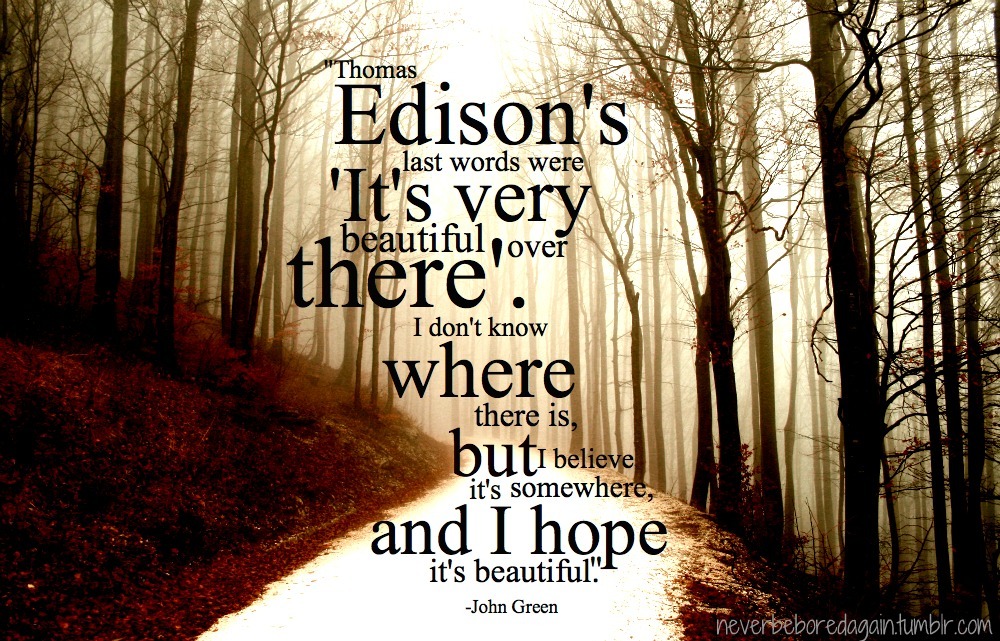
("Thomas Edison's last words were: 
'It's very beautiful over there.' 
I don't know where there is, but I believe it's somewhere, 
and I hope it's beautiful." )

Saturday, June 9, 2012

BOOK REVIEW: Between Shades of Gray


“In the depth of winter, I finally learned that within me there lay an invincible summer.”           
                     —Albert Camus


 I’ve never really cried reading a book (perhaps a slight wateriness in the eyes, but a tear has never escaped); I’m sad to say that I’ve cried in at least a movie or two, but never in a book, not even in Where the Red Fern Grows like the rest of my sixth grade class.  However two nights ago, around midnight, that changed.  What was it about Ruta Sepetys' novel, Between Shades of Gray ?  I’m not really sure.  There is so much I feel about this novel that I don’t even know if I could put into words right now, but I hope I can convey at least a fraction of the beauty, power and importance of this incredible story. 

Sepetys took me on a journey on so many levels.  From the very first page, and especially the moment I stepped foot onto the car with Lina, I could feel that something was different about this book and that somehow, through mere words on paper, part of me had become part of Lina and I was one with her throughout her entire journey, and that her story wouldn’t be one I would easily forget.  Through the highs and utter lows, through the tinglings of first love to the pain of twelve hours of tortuous labor, through the anxiety and the despair, through the longing and hope through the terrifying fear and a most powerful love and an ability to retain faith and believe in humanity.


As readers of this novel, we are ripped along with the Vilkas family from the safe sanctuary of home.  We witness the questioning eyes of young and old, from the “bald man” to the little girl with her dolly on her knee to a newborn baby who had “been alive only minutes but was already considered a criminal by the Soviets”.  Death, sickness, and devastation spread rampantly, fear is instilled by a reign of terror.  Will any one survive?  Where will they take Lina and her family?  As you read you will wonder how did anyone actually survive this?  And how is it that they kept the flame of hope from
 being whisked away and that love in so many forms, first love, love of family, love of God, love of country and man, could take root and spread in a place so solidly cold and heartless. 

This is truly an incredible work of art, one that should be read by as many people possible.  Thank you Ruta Sepetys for this inspiring and powerful jar of words and images, with a story that honors those who have left us, those who persevere to this day and one that will carry all of their stories into the hearts of many.

From the Author’s note at the end:

“Some wars are about bombing.  For the people of the Baltics, this war was about believing... They chose hope over hate and showed the world that even through the darkest night, there is light.” 

~:~


Some of my favorite quotes:

-“Have you ever wondered what a human life is worth?  That morning my brother’s was worth a pocket watch.”

-“...little pink face in a bundle...The child had been alive only minutes but was already considered a criminal by the Soviets.”

-“I scanned the group...I saw courage, anger, fear and confusion.  Others were hopeless.  They had already given up.  Which was I?”

-“ ‘Are you always so pleasant?’ ”

-“I hated them, the NKVD and the Soviets.  I planted a seed of hatred in my heart.  I swore it would grow to be a massive tree whose roots would strangle them all.”

-“ ‘Do you really think they need our permission, our signatures, to do what they’re doing to us?  Stalin needs to break our will.  Don’t you understand?  He knows if we sign some stupid papers, we’ll give up.  He’ll break us.’ ”

-“My art teacher had said that if you breathed deeply and imagined something, you could be there.  You could see it, feel it.  During out standoffs with the NKVD, I learned to do that.  I clung to my rusted dreams during the times of silence.  It was at gunpoint that I fell into every hope and allowed myself to wish from the deepest part of my heart...he thought he was torturing us.  But we were escaping into a stillness within ourselves.  We found strength there.”

-“ ‘No.  Don’t be scared.  Don’t give them anything, Lina, not even your fear.’ ”

-“I pulled my coat closed and put my hands in my pocket.  That’s when I felt it.  The stone.”

-“Hello Lina. You’ve gotten to page 278.  That’s pretty good!... Are you really on page 300 or are you skipping ahead now?”

-“There were only two possible outcomes in Siberia.  Success meant survival.  Failure meant death.  I wanted life.  I wanted to survive.” 


Some other great reviews and articles on the book: